The Promise That Sparked a Revolution
Remember when Intel announced Loihi back in 2017? I was practically vibrating with excitement, poring over every technical detail in their Nature Machine Intelligence papers until well past midnight. Here was a chip that mimicked the brain’s neural networks at the hardware level, complete with spiking neurons and adaptive synapses etched into silicon. The promise was intoxicating: computers that could learn like biological systems, consuming a fraction of the power while adapting in real-time to new information.
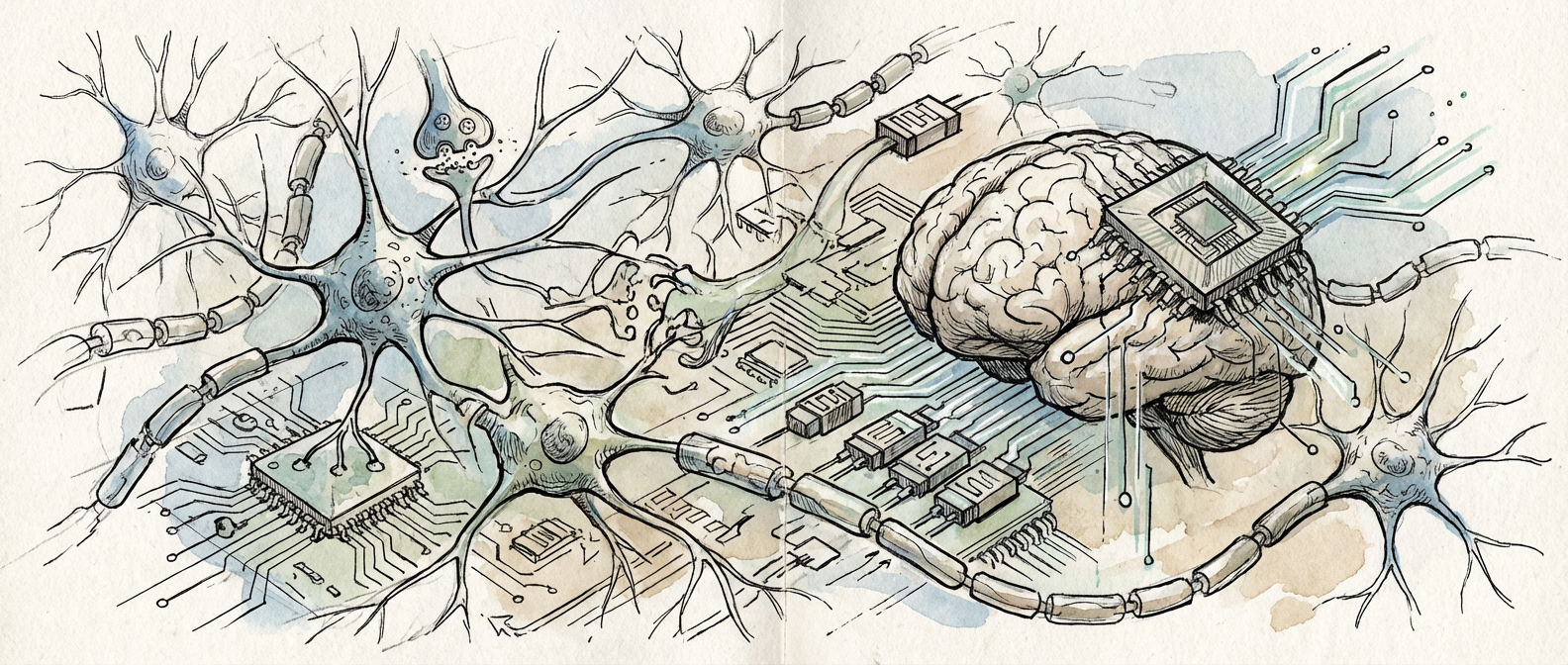
Neuromorphic computing felt like the next obvious step. Traditional von Neumann architectures shuttle data back and forth between separate memory and processing units, burning energy with every transfer. But the brain? It processes and stores information in the same neural structures, achieving remarkable efficiency. Loihi’s 128 neuromorphic cores, each containing 1,024 artificial neurons, seemed ready to bridge that gap between biological inspiration and silicon reality.
The early demonstrations were genuinely impressive. Researchers showed Loihi learning to balance a pole in real-time, adapting its neural connections as it practiced. Others demonstrated gesture recognition that improved continuously without explicit retraining. These weren’t just small improvements over existing approaches, they represented a fundamentally different computing paradigm that promised to unlock new possibilities in robotics, edge AI, and adaptive systems.

The Reality Check Nobody Wanted
But here’s where the story gets interesting, and honestly, more scientifically valuable. As more research groups got their hands on Loihi chips through Intel’s research program, a different picture began to emerge. The power efficiency gains, while real, weren’t the revolutionary leap many had expected. In head-to-head comparisons with optimized conventional processors, Loihi often showed only modest improvements, and sometimes performed worse depending on the task.
The programming model proved far more challenging than anyone expected. Writing code for spiking neural networks requires thinking in fundamentally different terms: temporal coding, spike timing, membrane potentials. Many researchers found themselves spending months learning new frameworks like SLAYER and Norse, only to achieve results they could have obtained more quickly with traditional approaches. The learning curve wasn’t just steep. It was nearly vertical.
More frustratingly, the adaptive learning that made neuromorphic computing so appealing in theory often behaved unpredictably in practice. Unlike the carefully controlled training of conventional neural networks, on-chip plasticity could lead to catastrophic forgetting or unstable weight dynamics. Teams would achieve promising initial results, only to watch their systems gradually degrade over time as the synaptic weights drifted away from optimal values.
By 2023, Intel quietly began winding down active development of Loihi, transitioning focus to their next-generation Loihi 2 research platform. While they framed this as natural evolution, the writing was on the wall: the first generation of neuromorphic chips hadn’t delivered the transformative impact the field had hoped for.
What Went Wrong Wasn’t Actually Wrong
Here’s what fascinates me about Loihi’s trajectory: the “failure” revealed important insights about the gap between neuroscience and engineering. We’ve been inspired by the brain for decades, but translating biological principles into silicon turns out to be far more complex than simply mimicking neural structures. The brain’s efficiency comes not just from its architecture, but from billions of years of evolutionary optimization that we’re only beginning to understand.
The timing turned out to be particularly challenging. While Loihi was being developed, conventional AI accelerators like GPUs and TPUs were undergoing their own dramatic improvements. NVIDIA’s successive generations of tensor processing units kept raising the bar for AI performance per watt, making the efficiency advantages of neuromorphic computing less compelling. It’s a classic case of competing technologies evolving simultaneously, sometimes the revolutionary approach gets overtaken by incremental improvements to the established paradigm.
The software ecosystem challenge revealed something deeper about technology adoption. Even brilliant hardware needs accessible tools and extensive libraries to gain traction. CUDA succeeded not just because of GPU hardware, but because NVIDIA invested heavily in making parallel programming approachable. The neuromorphic community, fragmented across multiple platforms and programming models, never achieved that necessary mass of developer adoption.
What Silicon Taught Us
But dismissing neuromorphic computing as a failed experiment would be shortsighted. Loihi’s development pushed the boundaries of our understanding in fascinating ways. Researchers discovered new insights about sparse computation, event-driven processing, and the relationship between timing and information encoding. These concepts are already finding their way into conventional AI accelerators, many of today’s edge AI chips incorporate some form of sparse computation inspired by neuromorphic principles.
The programming challenges also spurred innovation in brain-inspired algorithms. The frustrations of working with spiking networks led to breakthroughs in temporal coding schemes and new approaches to online learning that don’t require the massive datasets typical of deep learning. Some of these techniques are now being adapted back to conventional neural networks, creating hybrid approaches that combine the best of both worlds.
Perhaps most importantly, Loihi forced the neuromorphic community to confront the hard questions about what biological inspiration actually means in engineering practice. It’s one thing to be inspired by the brain’s architecture. It’s another to understand which aspects of that architecture are essential and which are evolutionary accidents we shouldn’t try to replicate in silicon.
Beyond Loihi: The Next Chapter
The story doesn’t end with Loihi’s transition to research-only status. Companies like BrainChip, GrAI Matter, and SynSense are taking different approaches to neuromorphic computing, learning from Intel’s experience while exploring new architectural possibilities. Academic groups are developing hybrid neuromorphic-digital systems that combine the adaptive learning of spiking networks with the programmability of conventional processors.
What excites me most is how this “failure” is reshaping the field’s approach. Instead of trying to replicate every aspect of biological neural networks, researchers are becoming more selective about which brain-inspired principles actually translate to engineering advantages. The focus is shifting from pure bio-mimicry to bio-inspired efficiency, taking the best ideas from neuroscience while remaining grounded in silicon realities.
The power efficiency question remains compelling, especially as edge AI applications proliferate. While Loihi didn’t achieve the revolutionary improvements initially hoped for, it demonstrated that alternative computing paradigms can work in silicon. That proof of concept, combined with lessons learned about programming models and system integration, provides a foundation for the next generation of neuromorphic approaches.
Science moves forward through exactly these kinds of ambitious experiments that don’t quite work as expected. Loihi’s legacy isn’t in market success or revolutionary performance gains, it’s in the deep understanding gained about the challenges and possibilities of neuromorphic computing. Sometimes the most valuable experiments are the ones that force us to refine our assumptions and ask better questions. What aspects of brain-inspired computing are you most curious about? I’d love to hear your thoughts on where this field heads next.