The Mission That Almost Didn’t Happen
In October 2024, NASA launched the Europa Clipper on a journey that felt overdue by decades. Europa has fascinated planetary scientists since the Voyager probes first spotted its cracked, icy surface in 1979. But fascination alone doesn’t fund missions, and for years Europa remained tantalizing but out of reach. Then came the data. The Hubble Space Telescope spotted plumes shooting from beneath Europa’s ice shell in 2018, and suddenly there was urgency. Water vapor. Active geological processes. A moon that was clearly telling us something if we would just listen closely enough.

Now we’re listening. In late 2025, Europa Clipper completed its first close flyby of Europa, swooping to within 25 kilometers of that icy surface. The spacecraft went from being a piece of sophisticated engineering to delivering preliminary answers to questions we’ve carried for nearly a decade. What the instruments found is already forcing us to revise our understanding of what ocean worlds look like and, more importantly, what conditions they might support.
Complex Chemistry in the Plumes: A Hint of Organic Possibilities
The mass spectrometer aboard Europa Clipper did exactly what it was designed to do: sniff the plume material ejected from Europa’s subsurface ocean. What it detected matters. Complex carbon-bearing compounds. Organic molecules. This wasn’t just a confirmation of the 2018 Hubble findings that hinted at plume activity. This was the same story told in far greater detail, with chemical signatures that expand the narrative considerably.
Here’s the crucial distinction when you’re trying to assess habitability: organic compounds are not life. They are not even necessarily a sign that life exists. But they are the molecular building blocks that life, as we understand it, depends upon. Finding them in Europa’s plumes means they are actively being transported from the subsurface ocean to the surface where instruments can detect them. The plumes are acting like a natural sampling system, bringing material from the depths up to where we can analyze it. This is exactly the kind of access point that makes Europa scientifically precious.
The presence of these molecules also tells us something about the ocean environment itself. Carbon-bearing compounds don’t just materialize. They form through chemical processes, and their complexity suggests an ocean with interesting chemistry happening. Not a static, sterile water column, but an environment where reactions are occurring, where energy is being tapped for chemical synthesis. That distinction matters enormously for the question of habitability.
Beneath the Ice: What the REASON Radar Is Beginning to Reveal
Europa Clipper carries nine science instruments, but the ice-penetrating radar called REASON is particularly important for answering the big questions. This instrument can probe up to 30 kilometers beneath Europa’s icy crust, giving scientists a way to see through the moon’s frozen exterior to the ocean below and the geology in between. The first data from REASON is already reshaping our models of the ice shell’s structure.
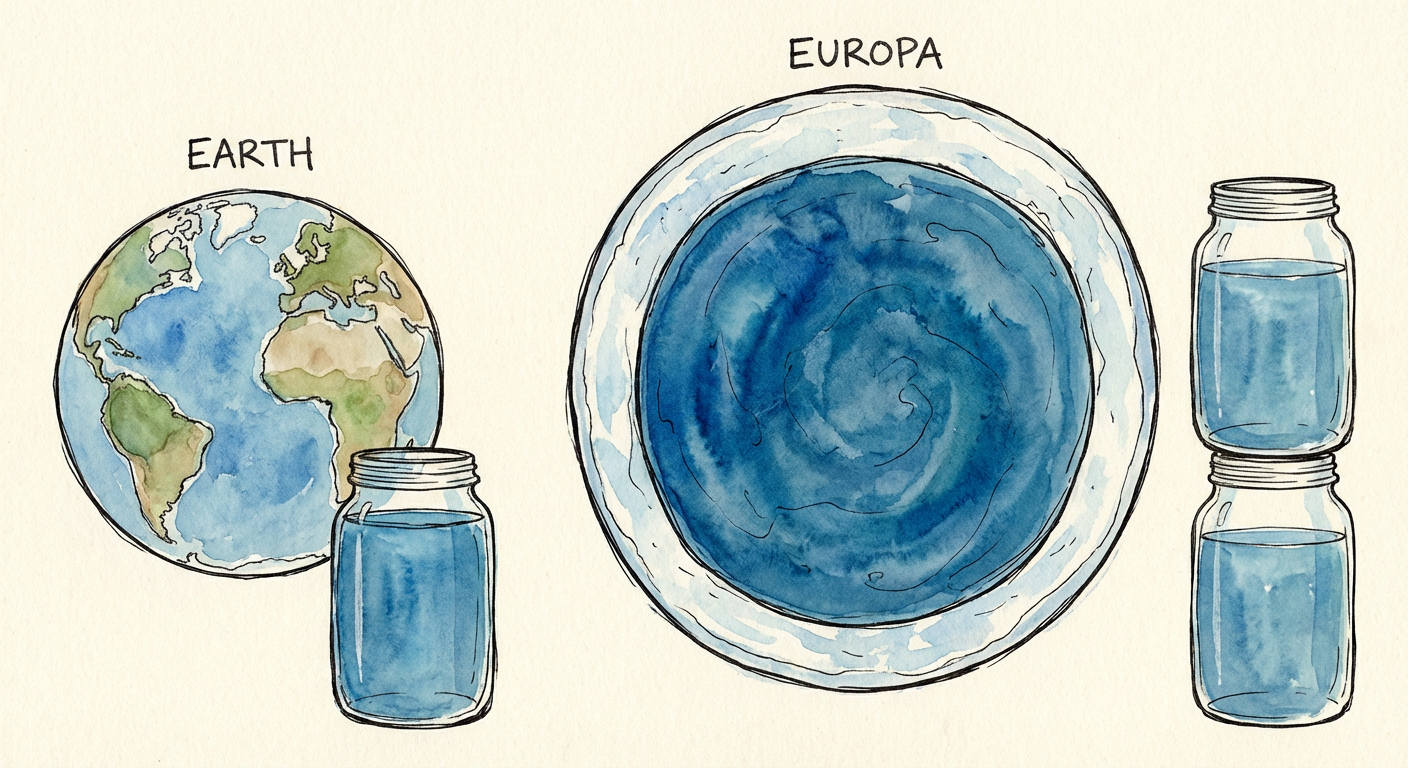
The numbers alone are staggering. Europa’s subsurface ocean contains twice the volume of all Earth’s oceans combined. Let that sink in. We spend enormous resources studying Earth’s oceans and the life they contain. Europa’s ocean is twice as large, and we’ve never directly sampled it. That volume alone suggests different thermodynamic regimes, different pressure gradients, different zones that might support different types of chemical and potentially biological processes. Understanding the ice shell above that ocean is the key to understanding what happens below.
REASON’s data is revealing that the ice shell is more complex than simple models suggested. There are thicker regions and thinner regions. There are areas where the ice may be warmer and potentially more geologically dynamic. These variations matter because they indicate where energy from below might reach upward, where the boundary between ice and ocean might be most active. On Earth, the most dynamic biological communities often exist at boundaries and interfaces. The same principle likely applies on Europa.
Hydrothermal Vents: The Ecosystem Template We Already Know Works
Here’s what makes Europa genuinely compelling as a potential habitat for life: we already have a working example of a biosphere that operates on principles very similar to what we expect to find there. Deep-sea hydrothermal vents on Earth support entire ecosystems completely independent of sunlight. Chemosynthetic bacteria use the chemical energy from vent fluids to build organic matter. Larger organisms cluster around these oases, creating pockets of life in the deep ocean where sunlight never penetrates.
Recent research compiled in a 2025 Nature Geoscience review has strengthened the case that Europa’s ocean floor likely experiences hydrothermal activity similar to Earth’s deep-sea vents. This isn’t speculation based on nothing. The geological processes that create hydrothermal vents on Earth involve water interacting with hot rock in the presence of chemical gradients. Europa’s smaller size and internal heating suggest that similar processes would occur there. The ocean floor is probably warmer than the water column above it. The rocks are probably actively interacting with the water. Energy gradients probably exist. All the ingredients that support Earth’s vent ecosystems could be present.
What this means is that we’re not trying to imagine some alien biosphere operating on exotic principles we’ve never observed. We’re looking for something we have a template for, something we know works because we see it every day in Earth’s oceans. The bar for habitability on Europa isn’t impossibly high. It’s something we can actually think clearly about because we have direct experience with analogous systems.
From Data to Decisions: Why This Matters Right Now
The early results from Europa Clipper aren’t just interesting trivia about a distant moon. They are directly influencing how we prioritize future exploration. NASA Europa Clipper Mission Overview represents the first phase of a multi-mission program to study this world. The data we’re receiving now shapes the design of subsequent missions, particularly the Europa Lander being planned for the 2030s. Understanding the plume composition helps us decide what instruments to send. Understanding the ice shell structure helps us plan where to land. Understanding the potential for hydrothermal activity helps us think about what signatures would indicate biological or pre-biological chemistry.
Consider the practical implications. If we find robust evidence of complex organic chemistry in Europa’s ocean, and if we can locate regions of likely hydrothermal activity, then the strategic question becomes focused: how do we access that ocean? Do we drill through ice that’s potentially 20 kilometers thick? Do we wait for a future mission that lands near an active plume region? Do we design instruments that can detect biosignatures from orbit before we ever land? These aren’t academic questions. They determine where funding goes, what technologies we develop, and ultimately whether we answer one of the deepest questions in science within our lifetimes.
The story isn’t finished. Europa Clipper will continue its mission, conducting multiple flybys over the coming years, collecting data that will be analyzed and reanalyzed by thousands of scientists worldwide. We’re at the beginning of a discovery phase, still taking the first careful measurements of a world we barely understand. But what we’re seeing so far suggests the wait was worth it, that Europa is probably more interesting than even our most optimistic models suggested, and that we’re closer to understanding whether life exists beyond Earth than we’ve ever been. That’s the kind of possibility that keeps scientists like me awake at 3 a.m., refreshing data feeds and reading preliminary results. The unknown is calling, and we’re finally in a position to answer.
What aspects of Europa’s chemistry or geology are you most curious about? We’re moving from speculation to evidence, and every new measurement opens up fresh questions. The conversation is just beginning.