Beyond the Fifty-Year Promise
Fusion energy has been the perpetual “technology of the future” for so long that the joke has become tired. But something shifted in the past few years, and the shift wasn’t just another incremental improvement in plasma confinement or magnetic field strength. The entire ecosystem around fusion research transformed. Where once a handful of government laboratories wrestled with the physics in isolation, we now see dozens of public-private partnerships, venture capital investments, and startups approaching the challenge from radically different angles.
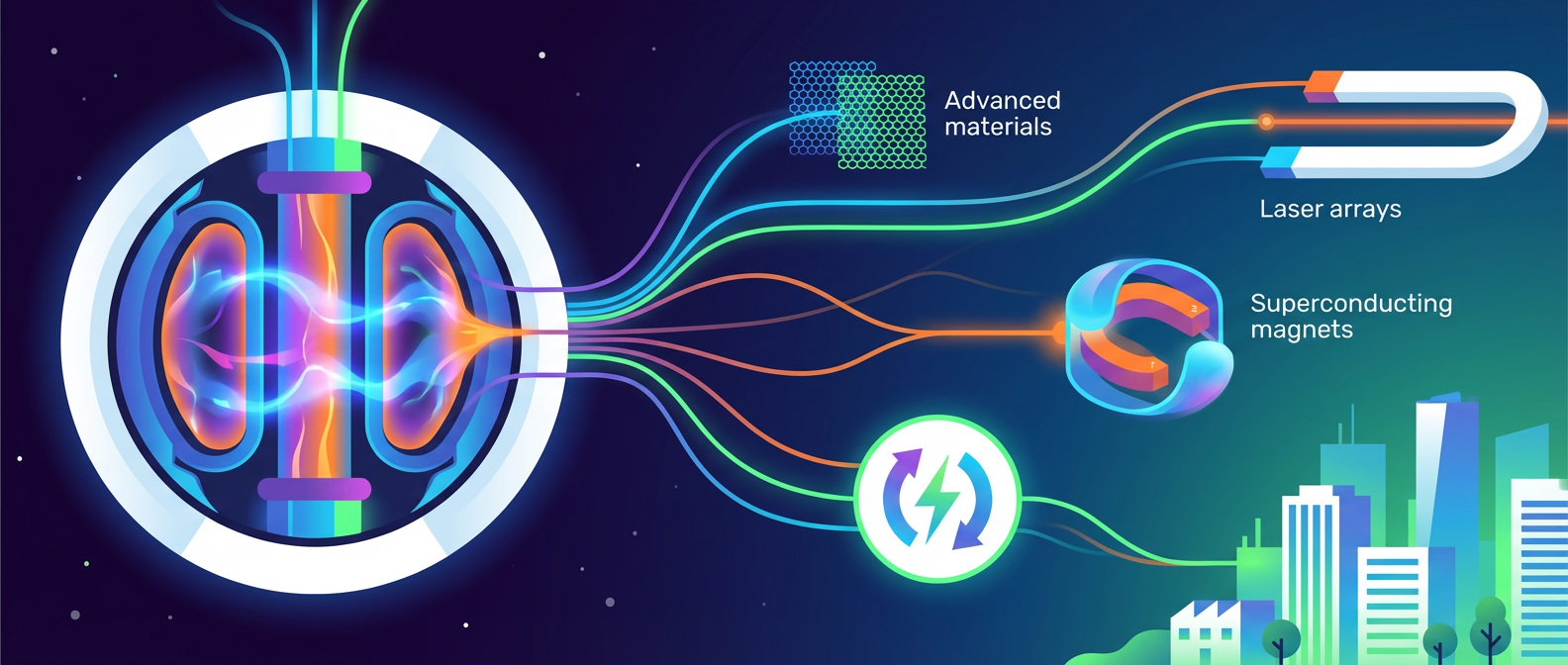
The breakthrough moment everyone points to happened on December 5, 2022, when researchers at the National Ignition Facility achieved fusion ignition for the first time. The laser-driven experiment produced more energy from fusion reactions than the lasers delivered to the target. But here’s what made this moment different from previous fusion milestones: it wasn’t just about the physics. The timing coincided with a mature ecosystem of companies, each betting their own approach could scale from laboratory curiosity to commercial reality.
What strikes me most about today’s fusion world isn’t the technology alone, but how the community has learned to balance breathless optimism with hard-earned skepticism. After decades of overpromising, today’s fusion researchers speak more carefully about timelines and technical hurdles. They’ve watched too many promising approaches hit unexpected walls to claim victory prematurely.

The Magnetic Confinement Renaissance
Tokamaks, those doughnut-shaped magnetic bottles that have dominated fusion research for decades, are experiencing a renaissance. But not in the way most people expect. While ITER continues its methodical construction in southern France, private companies like Commonwealth Fusion Systems and TAE Technologies are exploring whether smaller, more agile tokamak designs could reach commercial viability faster than the international megaproject approach.
Commonwealth Fusion’s SPARC reactor is perhaps the most audacious bet in the field. They’re using high-temperature superconducting magnets to create magnetic fields twice as strong as ITER’s, allowing them to build a machine roughly one-tenth the volume while targeting similar performance. The physics looks sound, but the engineering challenges are immense. Creating and maintaining magnetic fields that strong requires materials and manufacturing techniques that barely existed five years ago.
Meanwhile, researchers at private companies are questioning fundamental assumptions about tokamak design that government labs couldn’t easily abandon because of sunk costs and institutional momentum. TAE Technologies has built a reactor that combines features of tokamaks and field-reversed configurations, creating a hybrid approach that might sidestep some traditional tokamak limitations. Their machine operates with a different type of plasma entirely, one that burns hydrogen and boron instead of the deuterium-tritium fuel most fusion researchers favor.
The human side of this magnetic confinement revival fascinates me. Many of the scientists leading these efforts spent years or decades working within the constraints of large government programs. Now they find themselves with unprecedented freedom to test ideas that might have languished in committee review for years. The energy in these teams is palpable, but so is the pressure. Private investors expect results on timescales that would have seemed absurd to fusion researchers just a generation ago.
Alternative Approaches Gaining Momentum
Perhaps the most intriguing development in fusion isn’t happening in tokamaks at all. Inertial confinement fusion, the approach that achieved ignition at NIF, is spawning a new generation of commercial concepts. Companies like Marvel Fusion and Focused Energy are developing laser systems specifically designed for power generation rather than weapons research. Their challenge is formidable: they need to compress fuel pellets with the precision achieved at NIF, but thousands of times per day instead of once per experiment.
Target fabrication is an equally daunting challenge. Each fuel pellet must be manufactured to tolerances measured in nanometers, then delivered to the reaction chamber and positioned with extraordinary precision. The manufacturing techniques required don’t exist yet, but the companies pursuing this approach believe they can adapt technologies from semiconductor fabrication and precision machining to meet these demands.
Field-reversed configuration reactors offer another alternative pathway. These machines create and maintain plasma structures that naturally confine themselves through their own magnetic fields. TAE Technologies has operated their current machine continuously for longer than any other private fusion experiment, suggesting the approach might offer advantages in practical operation even if the peak performance lags behind tokamaks.
What excites me about these alternative approaches isn’t just their technical merit, but how they’re forcing the entire fusion community to reconsider basic assumptions. When everyone pursued tokamaks, certain engineering challenges seemed insurmountable. With multiple approaches under active development, problems that stumped one design might find solutions in another, and the cross-pollination of ideas accelerates progress across the entire field.
The Engineering Reality Check
The closer fusion gets to commercial reality, the more the conversation shifts from physics to engineering. Creating a self-sustaining fusion reaction is one challenge. Building a power plant that can operate reliably for decades while subjected to intense neutron radiation is another challenge entirely. The materials science problems alone could occupy researchers for years.
Fusion neutrons carry enormous energy, roughly 14 million electron volts each. They slam into reactor walls and gradually transform the metal’s crystal structure, making it brittle and radioactive. Current estimates suggest reactor components might need replacement every few years, turning what should be a clean energy source into a complex waste management challenge. Several companies are developing new materials and reactor designs specifically to address this issue, but the solutions remain largely untested.
The tritium fuel cycle is another sobering reality. Most fusion reactor designs burn deuterium and tritium, but tritium doesn’t exist naturally in useful quantities. Fusion plants must breed their own tritium by bombarding lithium with neutrons, creating a complex fuel cycle that’s never been demonstrated at scale. Getting this cycle wrong could leave fusion plants unable to sustain their own reactions.
Yet speaking with engineers at fusion companies, I’m struck by their pragmatic optimism. They acknowledge these challenges while maintaining confidence that engineering solutions exist. Many have experience with similarly complex technical challenges in aerospace, semiconductor manufacturing, or particle accelerator construction. They approach fusion not as an impossible dream, but as an extremely difficult engineering problem with enormous potential rewards.
Looking Forward Without Rose-Colored Glasses
The fusion energy field stands at an inflection point. Decades of physics research have finally converged with advances in materials science, manufacturing, and computational modeling to make commercial fusion seem genuinely achievable. Multiple viable approaches are under active development, each with dedicated teams and substantial funding. The question has shifted from whether fusion can work to which approach will scale most effectively.
But I’ve learned to be cautious about fusion timelines. The field has a long history of underestimating engineering challenges and overestimating the pace of technological development. Today’s fusion entrepreneurs claim they’ll have working reactors within the decade, but similar predictions have been made before. What feels different this time is the diversity of approaches and the quality of the engineering talent involved. Even if individual companies fall short of their ambitious timelines, the collective effort seems likely to produce significant breakthroughs.
The most honest assessment might be that fusion has finally graduated from a physics experiment to an engineering challenge. That transition brings fusion closer to commercial reality than ever before, but it also reveals the true scale of the work ahead. We’re no longer asking whether fusion is possible, but how quickly we can solve the engineering puzzles that stand between laboratory demonstrations and practical power plants.
What aspects of fusion development do you find most intriguing? Are you tracking particular companies or technical approaches? I’d love to hear your thoughts on where you think the biggest breakthroughs might come from, especially as someone who appreciates both the promise and the challenges of transformative technologies.