When a Volcano Rewrites the Rules of What We Thought Was Possible
Three years ago, on January 15, 2022, Hunga Tonga-Hunga Ha’apai did something that caught atmospheric scientists completely off guard. The submarine volcano in the South Pacific didn’t just explode. It injected approximately 150 teragrams of water vapor directly into the stratosphere, shattering the previous record for such an injection in the entire era of satellite observation. To put that in perspective, that’s roughly equivalent to the total water vapor content of 60 million Olympic swimming pools, sent vertically into the upper atmosphere instead of spread across the ocean’s surface. I found myself reading the 2023 Nature paper on this event at 2 in the morning, genuinely unable to put it down. This wasn’t just a big eruption. It was a disruption to a system we thought we understood.

What made this event so scientifically significant wasn’t merely its size, though size certainly matters. The explosive force of Hunga Tonga generated atmospheric pressure waves that circled the entire planet multiple times. A 2 hectopascal pressure anomaly was recorded as far away as the United Kingdom. Weather stations everywhere picked up the signal. The eruption had essentially given the entire Earth’s atmosphere a sharp, measurable jolt, and that jolt carried consequences still unfolding as we head into 2025.
The Stratosphere Remembers: Why Water Vapor Still Matters Years Later
Here’s where things get genuinely interesting and somewhat unsettling. Atmospheric water vapor should dissipate relatively quickly from the stratosphere under normal circumstances. Yet according to NOAA Stratospheric Water Vapor Monitoring data through 2025, stratospheric humidity remains elevated by 10 to 15 percent above pre-eruption baseline levels. That’s not a small deviation. That’s a persistent, measurable anomaly we’re still tracking nearly four years after the initial event. The water vapor has lingered far longer than conventional atmospheric models would have predicted.
This persistence has triggered a cascade of chemical effects in the stratosphere. Elevated humidity in the upper atmosphere directly influences ozone chemistry. Water vapor molecules interact with ozone-depleting compounds in ways that dry conditions do not. Researchers monitoring the ozone layer have had to account for this Tonga-related perturbation as a significant confounding variable in their analyses. And this isn’t just academic bookkeeping. The ozone layer protects life on Earth from harmful ultraviolet radiation. When we’re still seeing measurable compositional changes to the stratosphere years after an eruption, that deserves serious attention.
A Warming Signal That Keeps Giving
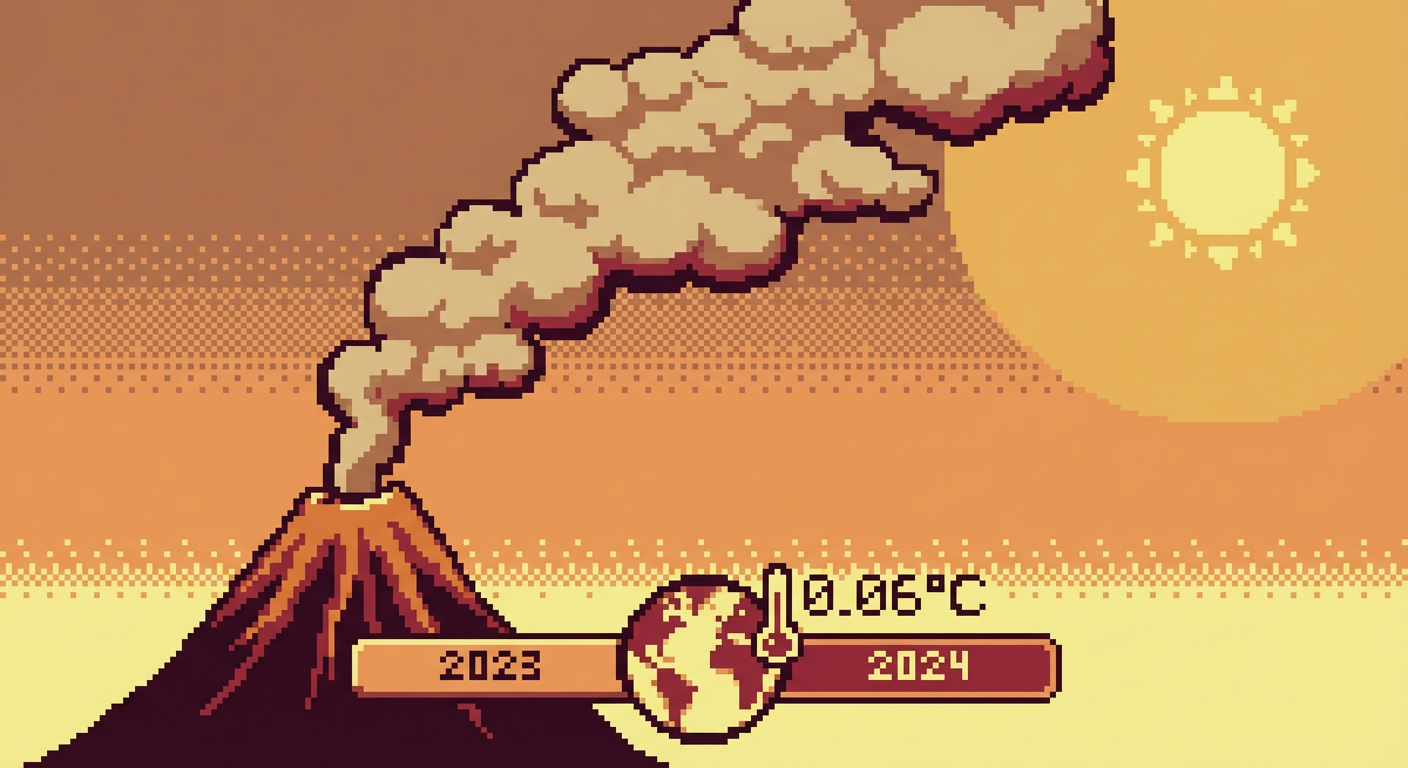
If stratospheric water vapor were just a curiosity, we might file it away and move on to other mysteries. But extra water vapor in the upper atmosphere has a direct warming effect at the planet’s surface. A 2025 study published in Geophysical Research Letters quantified something climate modelers have been theorizing about for years: the Tonga eruption’s stratospheric water injection contributed approximately 0.06 degrees Celsius of measurable surface warming during 2023 and 2024. That might sound tiny until you consider the context. Global temperature anomalies are measured in tenths of a degree. A warming signal of 0.06°C from a single volcanic event is a non-trivial fraction of the year-to-year temperature variations we track so carefully.
What intrigues me most about this finding is the mechanism. Volcanic eruptions are typically assumed to cool the planet because they inject reflective particles into the stratosphere that block incoming sunlight. Hunga Tonga did produce aerosols too, but the sheer quantity of water vapor it delivered overwhelmed the cooling effect. Water vapor in the stratosphere acts as a potent greenhouse gas, trapping infrared radiation that would otherwise escape to space. The net result was warming rather than cooling. This caught some scientists off guard and revealed how complex and context-dependent volcanic impacts on climate actually are.
Using a Volcano as Nature’s Climate Laboratory
Scientists love natural experiments, and Hunga Tonga has become exactly that. Researchers at Lawrence Berkeley National Laboratory published findings in early 2025 showing that the Tonga event provides an unprecedented natural test case for validating how accurately our climate models respond to stratospheric humidity changes. Climate models have built-in assumptions about how sensitive surface temperatures are to alterations in upper atmospheric water content, but models are only as good as their validation against real-world data. Having a single, dramatic event that injected an unprecedented amount of water vapor into the stratosphere gave modelers something concrete to work with. They could run simulations, compare predictions to actual atmospheric measurements and temperature records, then refine their models accordingly.
This iterative process of using Hunga Tonga as a testing ground is producing real improvements in our climate prediction capabilities. Nature — Hunga Tonga Stratospheric Water Injection Study established the foundational observations for this work, and the follow-up research has been methodical and rigorous. We’re not just collecting interesting data points. We’re using them to make our predictive frameworks more reliable, which matters enormously when forecasting how our climate will respond to future changes.
Why We Should Care About This Specific Volcano Three Years Later
The reason I keep coming back to the Tonga story is that it shows how atmospheric science actually works. We make predictions based on physical principles and historical observations. Then nature throws a curveball that forces us to reconsider our assumptions. The eruption didn’t violate any laws of physics, but it revealed that our understanding of how volcanoes interact with the climate system was incomplete. That’s not a failure of science. That’s exactly how science is supposed to work. We observe, we learn, we refine our models, and we move forward with better understanding.
The stratospheric effects of Hunga Tonga are still being actively studied in 2025. The water vapor that remains will eventually dissipate, but the scientific lessons won’t. Every observation we collect, every model we validate, every refinement we make to our understanding of stratospheric chemistry and climate sensitivity builds toward more reliable predictions about how our atmosphere behaves. If you’re curious about this work, I’d encourage you to dig into the research papers and monitoring resources yourself. What aspects of the Tonga aftermath intrigue you most? I’m genuinely interested in hearing what questions this raises for you.