The Child Who Shouldn’t Have Survived
In 2024, a child arrived at Great Ormond Street Hospital in London with T-cell acute lymphoblastic leukemia, one of the most aggressive blood cancers in pediatrics. Standard chemotherapy had failed. A bone marrow transplant wasn’t viable. The prognosis was grim. Then the medical team did something that would have seemed like science fiction a decade ago: they took the child’s own immune cells, rewrote their genetic code in four different places simultaneously, and sent them back to fight the cancer. Today, that child remains in remission. So do five others in the same cohort, with follow-up data now showing 75 percent of treated patients cancer-free at the 12-month mark. This isn’t just a win for pediatric oncology. It’s evidence that we’ve crossed a threshold in genetic medicine, and most people haven’t realized how significant the shift actually is.

The breakthrough matters not because gene editing cured leukemia—that’s remarkable but perhaps not shocking anymore. It matters because of how the editing was done. This distinction is why I’m writing this at 2:47 AM instead of sleeping like a normal person. The technique behind this cure is fundamentally different from the CRISPR methods that have dominated the headlines for years, and the implications reach into diseases we haven’t even begun to tackle.
Why Standard CRISPR Feels Like Wielding an Axe
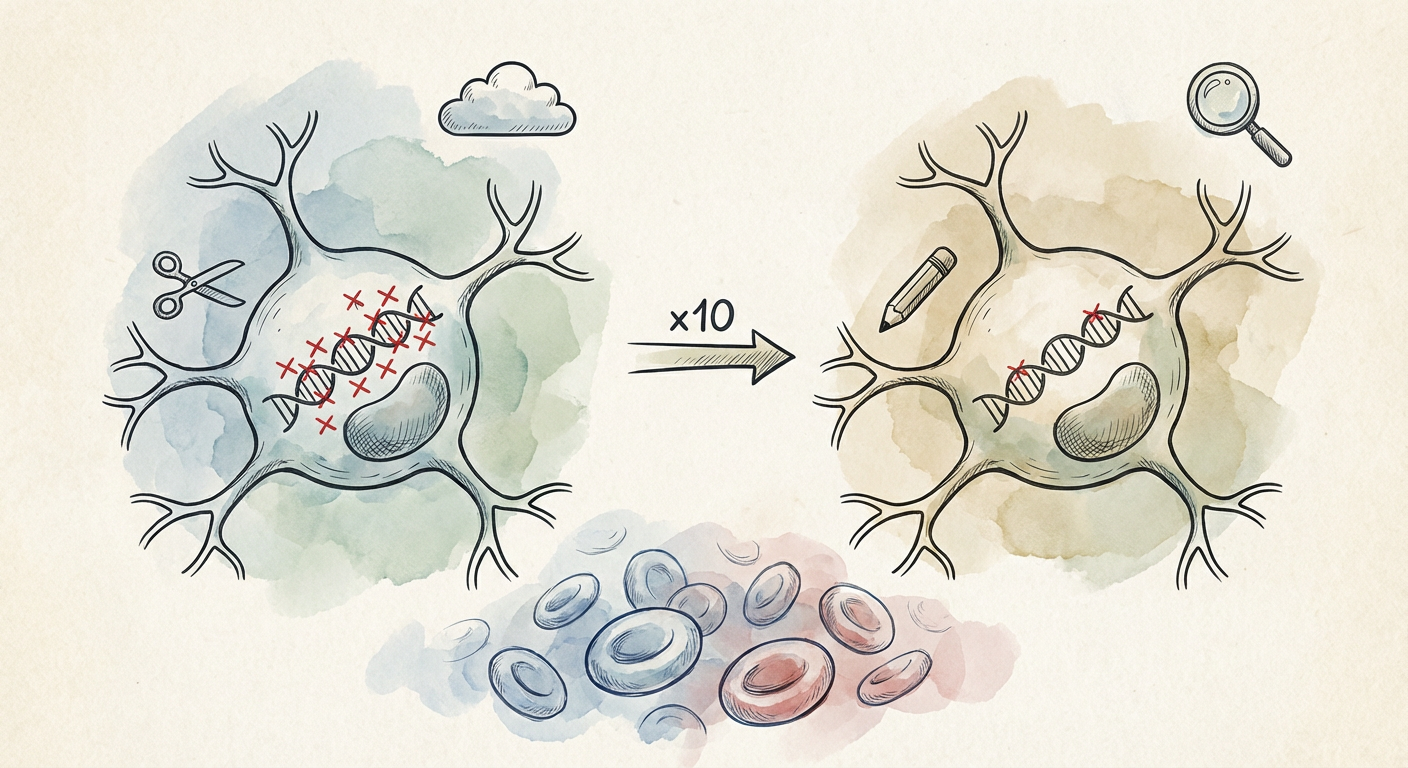
Most people know CRISPR as molecular scissors. The traditional CRISPR-Cas9 system cuts both strands of the DNA double helix at a target location, and the cell’s repair machinery stitches the break back together. This works, and it’s genuinely revolutionary. But here’s the problem nobody talks about enough: when you make a double-strand break, you’re asking the cell to perform emergency surgery on its own genome. Sometimes it gets the sutures right. Sometimes it doesn’t. Sometimes, while the cell is busy fixing your intentional edit, something goes wrong nearby. A chromosome gets rearranged. A large section of DNA vanishes. An off-target edit creates mutations in the wrong place. These are rare events individually, but scale them to millions of cells and the safety margin gets narrower.
A 2025 meta-analysis published in The Lancet examined off-target editing patterns across multiple studies using standard nuclease-based CRISPR in human blood-forming cells. The findings were sobering for CRISPR traditionalists: base editing reduced detectable off-target mutations by roughly 10-fold compared to the conventional approach. Let that sink in. Ten times fewer errors. That’s not an incremental improvement. That’s a categorical difference in safety profile.
Base Editing: The Whisper Instead of the Shout
Base editing doesn’t cut DNA at all. Instead, it chemically converts one DNA letter into another without breaking the strand. Imagine the difference between crossing out a word in a sentence and rewriting that exact letter. The sentence structure stays intact. The page doesn’t tear. The adjacent text doesn’t shift. Adenine becomes guanine. Cytosine becomes thymine. One letter changes, and that’s it.
The leukemia treatment developed by Waseem Qasim’s team at University College London is almost absurdly elegant in its complexity. They engineered donor T-cells with four simultaneous edits. The first makes the cells invisible to the patient’s immune system so they won’t be rejected. The second programs them to recognize and attack leukemia cells. The third renders them resistant to alemtuzumab, a chemotherapy drug the patient still receives. The fourth prevents them from attacking healthy tissue, eliminating the risk of a dangerous complication called graft-versus-host disease. Four genetic locks, all requiring precision, all with four reasons why the old CRISPR approach would have been riskier.
When you need to make multiple edits and you need them to be correct, base editing stops being an option and becomes a necessity. The technique allows researchers to work with much lower margins for error, and that matters when you’re engineering cells that will live inside a human body for years or decades.
The Broader Horizon: This Isn’t Just About Cancer
The leukemia story captured attention because childhood cancer is the kind of crisis that justifies experimental treatments. But base editing’s real power might lie elsewhere, in diseases where conventional CRISPR has been too risky to pursue. Beam Therapeutics Clinical Pipeline offers a window into what’s coming next. In their Phase 1/2 trial for sickle cell disease, their lead base-editing therapy achieved hemoglobin F induction above 40 percent in every single treated patient. Hemoglobin F is the form of hemoglobin we produce in the womb, and it doesn’t polymerize the way sickle hemoglobin does. Getting the body to produce more of it doesn’t cure sickle cell disease, but it transforms it from a life-threatening condition into something manageable. And they did this by editing a single gene in patient blood cells.
The possibilities unfold from there. Beta-thalassemia. Duchenne muscular dystrophy. Certain inherited blindness conditions. Diseases that were previously untreatable because the standard CRISPR approach created risks that outweighed the benefits. Base editing changes that calculation. It doesn’t make these diseases instantly curable, but it puts them on the table as targets worth pursuing.
For updated information on clinical trials and research progress, Great Ormond Street Hospital Gene Therapy Research maintains comprehensive documentation of their ongoing work with genetically modified T-cells and other approaches to pediatric blood disorders.
The Question We Should Be Asking
Here’s what keeps me awake: we’re still at the very beginning of understanding what base editing can do, and we’re already seeing results that rival or exceed what conventional CRISPR achieved after years of development. That suggests we’re not at the finish line. We’re not even at halftime. The child treated at Great Ormond Street isn’t a conclusion to this story. She’s an opening chapter.
The real question isn’t whether base editing will work for other blood cancers or genetic diseases. It probably will. The real question is whether we’re prepared, as a society, to scale up the infrastructure to make these treatments available before the next breakthrough renders them obsolete. Gene therapy isn’t coming. It’s here. Base editing just made it safer, more precise, and far more versatile. If you’re curious about what genetic medicine looks like when the technical barriers start coming down, you’re watching it unfold right now. What do you think happens when this becomes routine?